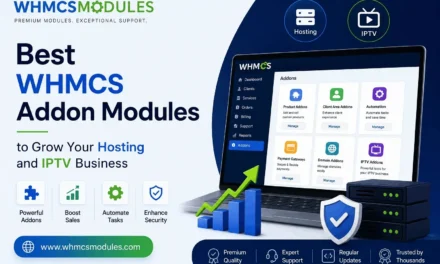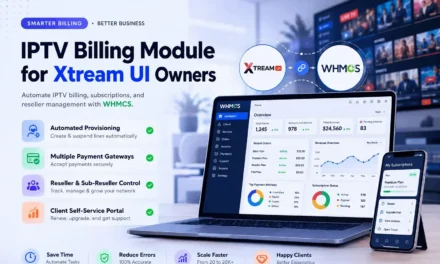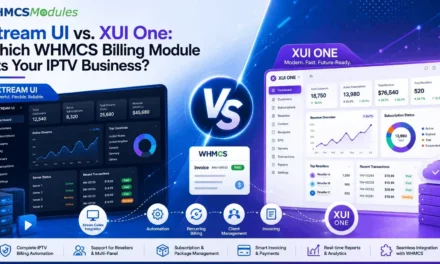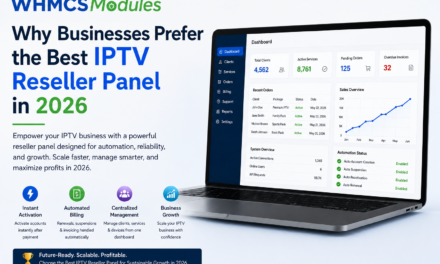
If you’ve ever run a hosting company or a subscription service, you know the feeling. It’s the 5th of the month, and you’re manually chasing three clients whose payments failed, while another customer is emailing asking why their invoice shows the wrong amount. Multiply that by a few hundred customers, and billing stops being a small task—it becomes a full-time job nobody wants.
This is the exact problem WHMCS modules were built to solve.
What Is WHMCS, Really?
WHMCS stands for Web Host Manager Complete Solution. It started out as billing software for web hosts, but these days it’s used far beyond hosting—VPN providers, SaaS platforms, and pretty much any business that charges customers on a recurring basis relies on it too.
Out of the box, WHMCS handles the basics: client accounts, support tickets, and invoicing. But the software becomes genuinely useful once you start adding modules to it.
So What’s a Module, Exactly?
Here’s a simple way to think about it. WHMCS is like a base operating system, and modules are the apps that make it do specific things. Want to accept payments through Razorpay? There’s a module for that. Want a customer’s VPN account to activate automatically the second they pay? That’s a provisioning module doing the work.
Without modules, WHMCS is just a client database with an invoicing page. With them, it becomes an automated billing engine.
Why Manual Billing Doesn’t Scale
Nobody sets out to run billing manually forever—it just happens because it feels manageable at first, until it isn’t.
Here’s where things usually go wrong:
- Invoices get sent late, or not at all
- Payment failures go unnoticed until a customer complains
- Refunds and cancellations require someone to remember to do them
- Staff spend hours each week on tasks a computer could do in seconds
According to Chargebee’s 2024 subscription billing report, businesses that switched to automated recurring billing saw failed payment incidents drop by close to 30% compared to those still relying on manual processes. That’s not a small number when you’re dealing with hundreds of monthly renewals.
How WHMCS Modules Actually Automate Payments
Payment Gateway Modules
These connect your billing system directly to processors like Stripe, PayPal, Authorize.net, or region-specific options like Razorpay. Customers pay through your own portal, and the money (minus fees) lands in your account without anyone manually reconciling anything.
Auto-Invoicing and Reminder Modules
Instead of someone remembering to send an invoice, WHMCS generates it based on the customer’s billing cycle and fires off reminder emails a few days before it’s due. Simple, but it makes a real difference in on-time payments.
Provisioning Modules
This one matters a lot for VPN and hosting businesses specifically. When a payment goes through, the module can instantly activate the customer’s service. When a payment fails repeatedly, it can suspend the account—no manual intervention needed either way.
Fraud and Security Modules
Some modules screen transactions for suspicious activity before they’re processed, which protects both the business and legitimate customers from chargebacks and fraud.
The Honest Pros and Cons
Nothing is perfect, so here’s a fair look at both sides.
What works well:
- Massive time savings on repetitive billing work
- Fewer mistakes than a human doing the same task by hand
- Scales fine whether you have 50 customers or 50,000
- A huge ecosystem of existing modules, so you rarely have to build from scratch
What to watch out for:
- Free or poorly maintained third-party modules can introduce security risks
- Some premium modules aren’t cheap, especially for smaller businesses
- Modules occasionally break after a WHMCS core update and need patching
The takeaway here isn’t “modules are perfect.” It’s that the time and error reduction usually outweighs the downsides, as long as you’re choosy about which modules you actually install.
Why This Matters for US-Based Businesses
For hosting and VPN providers serving US customers, the payment expectations are specific. Customers expect to see Stripe, PayPal, or major credit card processing at checkout, and they expect it to feel instant. Modules that handle ACH payments, sales tax calculation by state, and PCI-DSS compliant processing aren’t optional extras; they’re what keeps a business out of legal trouble and out of customer complaints.
There’s also the chargeback problem. US card networks make it fairly easy for customers to dispute a charge, and a business without proper fraud-screening modules in place can end up losing money to chargebacks even when the original transaction was legitimate. Automating fraud checks at the payment gateway level catches a lot of this before it becomes a dispute.
Final Thoughts
WHMCS modules aren’t just nice-to-have anymore. For any business running recurring billing whether that’s hosting, VPN services, or software subscriptions—they’re what separates a smooth, professional payment experience from one held together by manual effort and hope. Getting the right ones set up properly pays for itself pretty quickly, both in saved time and fewer unhappy customers.